
How To Invest In Exotic Cars: Understanding Value Stacks
If you've been following me long enough, you've heard me predicting the rise of the exotic car market - and the specific cars & specific times of their appreciation - for years.
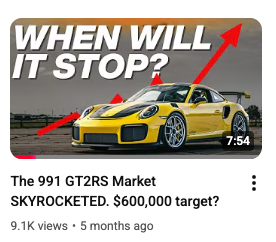
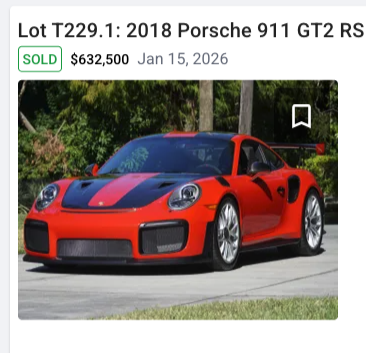
For example , I recently called the rise of the 991 GT2RS:
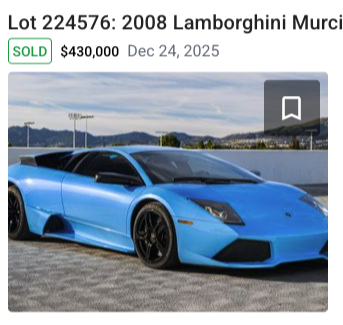
And also the Lamborghini Murcielago LP-640, which rose from ~$250K at the beginning of 2025 to $400K+ today.

I also called the rise of the collector car market in general back in December of 2024, and again in May.
If you think it's all just lucky guessing, think again.
Much as with stocks and options, there are clear patterns in alternative asset markets (like cars) that indicate when broad segments and specific assets are poised to rise.
The secret lies in understanding what I call "value stacks" - this is an approach to analyzing generational car pricing that goes far beyond the typical "buy low, hold through inflation" advice.
What Are Value Stacks?
Think of value stacks as layers of car values that build upon each other generationally.
Take Ferrari's lineup as an example: the 488 sits at the top of its stack, with the 458 below it, the 430 underneath, and the 360 at the base.
Each generation builds value on top of the previous one, creating predictable patterns that savvy collectors can exploit.
Different model lines create entirely separate stacks. The 812 Superfast, F12, 599, 575, and 550 form their own distinct value hierarchy, completely independent from the first stack.
And even the 575 and 550 have their own "sub stack" and transmission-specific off-chutes.
Step 1: Distance Analysis
The money is found by analyzing the pricing gaps across generations.
Let's use the Flagship V12 Lamborghini lineup to illustrate this concept, and ultimately what I saw that made me very bullish on LP640s in the beginning of last year.
NOTE: Pricing for cars like this varies GREATLY by year, spec, miles, and condition. I am using general pricing, not tied to specific units. So before you say "Oh BuT i SaW an LP640 foR $380K in NoVemBeR" just stop.
2025:
- Revuelto (newest): ~$650k average, many on market
- Aventador (middle generation): ~$450k average, many on market
- Murciélago (oldest): ~$250k and rising, few on market
Looking at this at first, it made sense. Equal gaps between all models.
But something was off.
The indicator at the beginning of 2025 that I noticed was that as Murcielagos were selling, new ones weren't entering the market.
The $225K car would go. The remaining 3 would go to $250K. The $250K car goes. The remaining 2 to go $270. A better car than both pops up, now at $300.
January 2026:
- Revuelto (newest): ~$650k average
- Aventador (middle generation): ~$450k average
- Murciélago (oldest): ~$400k and rising.
Notice now that the gap between Murciélago and Aventador average is now much smaller than the gap between Aventador and Revuelto.
This compression is the first indication that something else might be mispriced. Are Murciélagos overvalued? Are Aventadors undervalued? Will there be a "flippening?"
From here, we have to look closer, as the blended values from different trims now need to be separated and considered one by one.
Step 2: Internal Model Analysis
We can't stop at comparing different models. Within each model line, there are sub-stacks of specific trims or versions that reveal the true opportunities:
Here's What We See In The Murciélago Internal Hierarchy:
- LP670 SV (top tier): 2023 ~$900k, Today ~$1M
- LP640: 2023 ~$250k, today ~$450K
- Base Murciélago Automatic: 2023 ~$150K, today ~$300K
- Gated Manual Murciélago & LPs: 2023 ~$500K, today ~$900K
Here's where the analysis gets fun: gated LP640s often command higher prices than even the LP670 SVs, despite being a "lower" model. This illuminates arbitrage opportunities.
The Investment Strategy
When we see base Murciélagos pushing up against LP640 pricing, and LP640s creeping toward SV670 territory, we can predict market movements.
If SV670s maintain their $900K+ range while LP640s continue to rise, there's still a substantial $250K+ gap to capitalize on, because the bottom rising eventually pushes up the top.
(Alternatively, had SVs gone to $1.5M in that time period, the bullish car would be the gated manual cars)
Then What Does This Mean For The Aventador?
The next thing to consider is what I call the production gap.
The Avendator and Murcielago seem like they would be very closely correlated.
If Murici's are all moving up like crazy, even well into Aventador price territory, why aren't Avendators crushing right now?
Simply put: supply.
Manufacturing for exotic cars got REALLY f*ckig good around 2010. With the Volkswagen consolidation and parts & knowledge sharing across manufacturers, cars got easier to make in more volume. Lamborghini made about 4,000 Murci's between 2001-2010.
They made 11,000 Avendators between 2011-2022.
Nearly triple the supply.
That means on the Avendator side, you need to dig into that sub-stack and evaluate the base, S, SV, and SVJ stacks to see where the opportunity lies.
Step 3: Buying The Right Car
The ideal investment-grade exotic car combines several factors:
- Low mileage
- Correct model year (ex, the 2009 LP640 has a HUGE premium vs 2001 Murci)
- Desirable color inside and out.
- Right options package
- Strong market positioning within its stack
By understanding these value relationships and market dynamics, investors can identify undervalued assets before the broader market catches on.
"OK, But I Can't Afford A Ferrari or Lamborghini"
You probably can afford a better car than you think, but we'll talk about that another day.
Investment cars can be found in virtually any price range.
I called the R219 Mercedes SL500 back in 2021 when they were $20K.
Today good units fetch nearly $60K.
Other enthusiast models like BMW M3, Dodge Viper, Audi RS4, Corvette Z06, etc., all have stacks and opportunities to park money in cars safely.
The key is recognizing that exotic and specialty car values don't move randomly - they follow predictable patterns based on generational relationships, rarity factors, and market positioning.
Understand these concepts, study the markets for the cars you want to buy (this means often following them for months and years), and you'll be well-positioned to get paid to drive one of your dream cars.
I teach how to find the right investment car in detail in Advanced Wealth Transfer, along with how to apply similar strategies to watches, real estate, and handbags. Plus, I cover advanced tax techniques, art collecting, and much more.
And if you're too busy to do this research yourself, I also have a list updated quarterly of all the best investment cars to go after.
Ready to add An Investment Car to your portfolio?
Have questions or need help deciding what's best for you?